 Search
My STOMA is called Jupiter
My adult life had been a battle with a variety of issues and I had no way of knowing that the gastrointestinal issues I had experienced from my teens would be unexplained for 40 years. Despite a diagnosis of coeliac disease, the medical world had been unable to join-up the causes of my symptoms. I had been a keen athlete, ran marathons and off-road ultra distances. Then, at age 41 I experienced my first rectal prolapse and by 47 I could run no more without embarrassing rectal leakages.
Nothing had shown up on endoscopy and colonoscopy scans so I battled on. My diet was excellent. I was a fish-eating vegetarian; wheat gluten and lactose free; and high-quality hydration and nutrition to support the athletic lifestyle. However, coping with a bloated abdomen, constipation and diarrhoea was worsening each year. Then a colorectal consultant sent me for my first proctogram (X-ray fun whilst sitting on a potty!) and pelvic floor physiotherapy was recommended.
As a qualified sports therapist I was very knowledgeable about my own body. By my 40s, and into my 50s, I became plagued by musculoskeletal problems. Whilst I wasn’t treating obvious injury, I was forever rehabilitating one part or other and coping with worsening chronic joint and neuropathic pain in addition to the gut problems. Again, MRIs and X rays couldn’t diagnose anything specific. At 51 I had to give up running because of the chronic pain and fell in love with cycling. My aches and pains didn’t go away but simply relocated themselves.
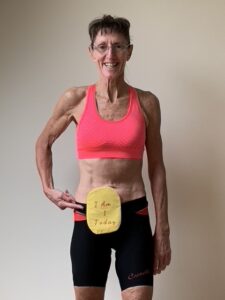
Deb and Jupiter
Finally at 54 in 2017, I was diagnosed conclusively with hypermobile EDS. The dots began to join up and I began to understand that my myriad of symptoms and co-morbidities (other illnesses and conditions) were connected.
As readers will know, hEDS is essentially faulty connective tissue. This is the material which is in the walls of blood vessels, the linings of all of the GI tract and forms our ligaments and tendons (and very much more). Mine is weak, fragile and overly stretchy. Its weakness creates havoc through many systems of the body. In my case the worst affected areas are my digestive system and ligaments. No wonder my gut couldn’t work properly and not surprising that I had suffered numerous prolapses. It explained why I had so much joint pain.
For many, hEDS is managed rather than treated, and the avoidance of erroneous interventions is vital. Fortunately, I have been able to prevent a lot of the common joint subluxations and dislocations some hEDS suffer because my muscles are really strong. Even before I had serious problems I had always done muscular conditioning. Now a day never goes by without a serious amount of focused Pilates, extra core work and weights in tandem with my endurance cycling routines.
In an effort to fundraise for EDS UK, in 2018 I set myself a seven day cycle challenge which saw me ride 515 miles from Poole to Minehead around the SW peninsula. Unfortunately, a few weeks before the event my serious colon problems became worse. I couldn’t pass anything and knew this wasn’t just constipation (obstructed defecation is a term I came to know and hate). My GP’s examination was inconclusive and I was prescribed very large quantities of Movicol to try to relieve things. It was as if my colon had shut down. The same thing reoccurred during the challenge yet somehow I made it to the end.
I was referred to a colorectal consultant who I saw a few months later. Episodes of going days and days without passing anything became more and more frequent and resulted in needing hospitalised enemas which gave minimal results. Another proctogram, a CT pneumocolon and a transit study finally provided some answers. Not only was I suffering prolapse of my rectum, my sigmoid colon was demonstrating intussusception (folding in-on itself like a telescope), the transit through my long redundant colon was extremely slow and I had a large omega loop. It was no surprise things weren’t getting through. The connective tissue laxity in my colon wall was simply not up to the job and the normal peristalsis action of a healthy colon wasn’t working.
Surgery wasn’t contemplated at the start. I was tried on drugs such a Linaclotide and Prucalopride (level 2 laxatives) and whilst this helped for a few weeks they stopped working. The only medication that gave any relief was the colon prep drug Picolax, and even then I needed a double dose or more. I spent many an hour in tears trying to use Peristeen self irrigation which the bowel and bladder clinic nurses had taught me to use. That didn’t work either. After eight months without proper bowel movements my mental well-being was in tatters.
Finally, the colorectal consultant and I talked about the best surgical options. I had carefully researched ileostomy surgery and knew that a sub total colectomy was the best way forward. There was little point in having a loop ileostomy. I said to the surgeon, “what’s the point of leaving behind plumbing that doesn’t work only to reconnect it if I don’t like living with a stoma!” One operation was enough for me so I agreed on an end Ileostomy and sub total colectomy.
Pre-surgery I researched numerous stoma supplies companies and had product samples sent to me. You may laugh, but I even filled up a bag with porridge, stuck it in on my abdomen where I thought my Jupiter was to be located and went for a bike ride! I wanted to know what it would feel like. It was fine and way better than I had thought.
My stoma is called JUPITER. Why? Because on planet Jupiter there is a spectacular red spot that is a wild and windy storm. He lives up to his name!
Debs Grill
Jupiter was born on September 3rd 2019 in RCHT Treliske, Truro. The first thing my surgeon said to me when a I came round was “that was a very worthwhile surgery”. He later showed me photos (at my request) and explained that my colon was never going to work. It was effectively strung up in loops and bends by congenital adhesions (strings of collagen) which shouldn’t be there. My guts were like a cat’s cradle and it was remarkable they had managed to get me to the age of 56!
At first my recovery went really well. Three days after my surgery I was due to go home but things took a surprising and drastic turn for the worse. I suffered a post-surgery haemorrhage on a BIG scale. The doctors took many hours trying to work out what was wrong as I repeatedly crashed (syncopal episodes). My very good fitness levels were masking the fact that I was bleeding out as my blood pressure kept recovering and the doctors thought I was having vasovagal attacks. Finally, a CT scan showed my bleed and I was rushed to theatre.
The surgeon told me the next day when he saw me in ITU that I had lost 75% of my blood (3.5 litres) and he had never had to use so many retrieval bags to remove the amounts of blood clots and blood from my abdomen. He found that one of the staples that was used on my rectal stump had burst and when re-stapled wouldn’t hold. He used sutures to stabilise it. I have since learned that patients with hEDS should never have staples during surgery as the collagen deficiencies means that the tissues are not strong enough to support them. So, if you are someone with hEDS who needs surgery, make sure your medical team know this. A staple nearly cost me my life.
Five days later I was able to go home. I was a lot less well than I had been in those few days after the elective surgery the week before. Non-the-less, I was thrilled to be going home albeit without enough haemoglobin in my body. It had dropped to 50 in theatre but recovered to 72 on my discharge so I was as weak as a kitten but fighting.
My first walk down the lane was six days later and after two weeks I was gently turning the pedals over on my stationary bike. Seven weeks after Jupiter was formed I went on my first bike ride and smiled the biggest smile I have ever, ever grinned. I was back!
Many things have had to change in the last two years, but with practice, patience and much experimentation, I am beginning to master this new lifestyle. The changes to my diet have been the most significant and extra time needed each day for my meal planning and preparation. I can’t eat out anymore, which is absolutely fine. Every single morsel has to be prepared by me so I know for sure I can digest it and it won’t mean a return trip to hospital with a blockage. I am still very prone to these because unfortunately the hEDS also affects my small intestine and stomach and so digestion is poor and transit is very slow. To be safe I only eat what I trust 100%.
It is time consuming and a bit tricky getting feeding right when also trying to fuel for 3/4/5 hour bike rides. My strategy for hydration took 12 months to get right and still needs vigilant monitoring. As many will know, the large intestine puts back 30% of your fluid requirements each day so without it you have to drink a lot. On hot days with long bike rides this can mean up to eight litres and quite a bit of electrolyte too! It’s a big juggling act, but it’s worth it. Fortunately, my sports nutrition training is a big help and I love cooking so I don’t see it as a hardship. My bike kit has been able to stay the same but I had to change the style of my jeans; that’s no big deal as who doesn’t like to shop!
This September I joined the “Pedal4Patients” group of doctors, nurses, researchers and practitioners from Royal Cornwall Hospital Charity in cycling a three day 200 mile “Tour of Cornwall” to say thank you to the whole team who have given me a new quality of life. We finished our epic route at Land’s End on Saturday 25th September. I have raised £5000 for the ward I was on post-surgery and the stoma unit. I shall never stop thanking them for saving my life and giving me back a lifestyle I love. I will always have hEDS but will never stop learning how to take the best care of myself I possibly can. Jupiter and I are the very, very best of friends. Long may it continue.