 Search
Spotlight on Dermatosparaxis Ehlers-Danlos Syndrome
Dr Chloe Angwin
Please note: The following text cannot and should not replace advice from the patient's healthcare professional(s). Any person who experiences symptoms or feels that something may be wrong should seek individual, professional help for evaluation and/or treatment. This information is for guidance only and is not intended to provide individual medical advice.
What is Dermatosparaxis Ehlers-Danlos Syndrome?
Dermatosparaxis EDS (dEDS) is a very rare type of EDS and so far only 19 individuals have been reported. The word “dermatosparaxis” means “tearing of the skin” as one the major features of this EDS type is extreme skin fragility. In 2017 major and minor clinical criteria were developed to help diagnose individuals with dEDS based on their clinical features (table 1). The diagnosis must be confirmed with genetic testing as dEDS is caused by autosomal recessive disease-causing alterations in the ADAMTS2 gene.
So far, there have only been 19 individuals reported worldwide of which the majority is reported in childhood. Recently, we reported on clinical features of five adul
ts with dEDS (Angwin et al., 2024, https://onlinelibrary.wiley.com/doi/10.1002/ajmg.a.63957). This provided more insight regarding clinical problems and their management in adulthood. A summary of management of clinical symptoms occurring in childhood and adulthood is visible in table 2.
Major clinical criteria for Dermatosparaxis EDS
-
- Extreme skin fragility with skin tears at or around birth
- Characteristic facial features, present either at birth or during early childhood
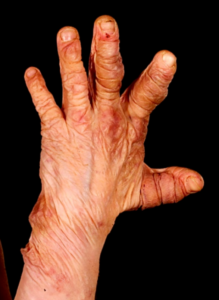
- Redundant, almost lax skin, with excessive skin folds at the wrists and ankles
- Increased palmar wrinkling
- Severe bruisability with a risk of subcutaneous hematomas and haemorrhage
- Umbilical hernia
Reduced growth in childhood
- Short limbs, hand and feet
- Perinatal complications due to connective tissue fragility
Minor clinical criteria for Dermatosparaxis EDS
- Soft and doughy skin texture
- Skin hyperextensibility
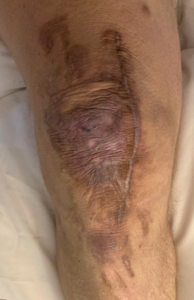
- Atrophic scars
- Generalised joint hypermobility
- Complications of organ fragility (e.g., bladder rupture, diaphragmatic rupture, rectal prolapse)
- Delayed motor development
- Osteopenia
- Excessive hair, particularly over body
- Tooth abnormalities
- Refractive errors (myopia, astigmatism)
- Strabismus
Autosomal Recessive inheritance
Dermatosparaxis EDS is caused by gene alterations in the ADAMTS2 gene. It is inherited in an autosomal recessive manner, affecting both men and women in equal numbers. Within our bodies exists two copies of our genes, with one being inherited from our mother and the other from our father. If both copies have a change which means that the gene cannot carry out its normal function, then that person would be affected with the condition. When only one gene alteration in the dEDS gene is inherited, a person is not expe
cted to display symptoms of dEDS and is called an unaffected carrier. Despite not being affected, carriers are still able to pass on the alteration to any children they may have. If both parents are carriers of dEDS, each child will have a 1:4 (25%) chance of inheriting both the gene alterations leading to them having the condition. There is also a 1:2 (50%) chance only one copy of the alteration will be inherited resulting in them being unaffected carriers, like their parents (see figure x).
How is Dermatosparaxis Ehlers Danlos Syndrome managed?
As there are so few people reported to have dEDS in the world, the information about how best to support them is limited. The current recommendations are management are:
Skin
• Protective clothing and avoidance of activities that could lead to skin injury
• Management plan by local plastic surgery team for any future traumatic or surgical wounds
• Avoidance of sutures where possible and instead use adhesive sutures/tapes and/or skin glues.
• Adhesive dressings should be soaked, or an adhesive remover should be used to avoid skin tears
• Manual handling should be avoided to prevent skin tears and rips. Silk or low friction fabrics should be used instead.
• Surgery to remove excessive, lax skin can be necessary
• Individuals are at risk of pressure sores if lying in one place for a prolonged period and the nursing team should be aware of this and manage accordingly
Musculoskeletal
• People may be at risk of bone fractures even with a normal bone mineral density. Their doctors should consider additional management from their Rheumatology team.
• Physiotherapy to maintain musculature and reduce likelihood of falls and injuries is important.
Organ fragility
• Affected individuals should carry medical alert jewellery and/or cards to highlight risk, and episodes of acute abdominal pain should be investigated thoroughly
Cardiovascular
• Individuals should have a one-off echocardiogram in adulthood, if normal they should have another one after the age of 40.
Access to healthcare
• The high risk of severe skin injuries means that some individuals with dEDS can develop anxiety or PTSD symptoms around healthcare settings.
• There can be difficultly in communicating the severity of their skin fragility and assumptions from the public and from healthcare professionals can make accessing correct healthcare difficult.
Conclusion
It is important for all people with EDS to always specify the type of EDS they have as that will help health care professionals to evaluate and manage their care better. This also applies to people with dermatosparaxis EDS which is a very rare, type of EDS with a specific underlying genetic cause requiring bespoke management.
References
Angwin, C., Byers, P., Dulfer, E., Ghali, N., Harris, J., Hausser, I., McElroy, A., Sobey, G., & van Dijk, F. S. (2025). The Natural History of Dermatosparaxis Ehlers Danlos Syndrome: An Adult Case Series. American journal of medical genetics. Part A, 197(4), e63957. https://doi.org/10.1002/ajmg.a.63957
You can read the paper here