 Search
My story – Punteha van Terheyden
There was a moment, sat on a bench while my husband pushed our daughter on the swings, that it dawned on me.
Something was very, very wrong with me. Otherwise, why, at just 36, was my mobility declining for no discernible reason? I couldn’t stand long enough to boil the kettle, couldn’t walk enough to get around the small Co-Op around the corner, or sit comfortably – anywhere?
My world had become immensely small and I had no real reason for it.
By chance, a video slid across my FYP on TikTok (the smart social media algorithm that curates videos it thinks are relevant to you) two summers ago, and it brought my world to a stop.
The woman was in her 30s, bending her joints this way and that, and telling viewers none of her range of motion was normal. She reeled off a list of symptoms, all of which I had, and said the words that changed my life: ‘none of this is normal and I can only do it because I hav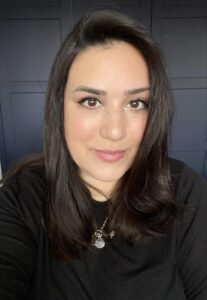 e hyperbole Ehlers-Danlos Syndrome.’
I knew then my life was about to change.
I am a journalist and prone to deep dives. I went off on one, reading every medical study I could, every news article I could find and eventually, pulled down the very-buried diagnostic criteria, and the GP’s hEDS checklist written by Dr Emma Reinhold, a zebra herself.
HEDS was the answer, I knew it. And after realising there was no care pathway for diagnosis and management in the NHS – and after my lovely GP’s referral to rheumatology was rejected – I went private, tracking down a brilliant hEDS specialist rheumatologist Dr Gyatri Mittal. She took a 45 minute full medical and family history, examined me, and confirmed I was right. The answer to my pain, injury, disability, and growing immobility was indeed hEDS.
For most, being told you have an incurable, painful, genetic condition that will bring you a lifetime of difficulty is not to be celebrated but for me, it was vindication.
Vindication of all the daily suffering I endured.
Vindication for every medic who had ever gaslighted me.
Vindication for every incorrect diagnosis I had ever received.
Vindication for every effort I’d put in and the strength of character I had shown to achieve so much in my career as a journalist and editor for the national press, despite my pain and increasing disability.
Vindication for the hard-won access to treatment and care I’d fought for.
At least now, I understood why things were so hard, and everything so painful. At least now I had a shot at being able to better manage my condition instead of shooting in the dark with no idea if I’d achieve any improvement with expensive treatments.
And, crucially, the diagnosis helped me stop feeling guilty all the time for everything.
The accommodations I needed to complete simple things. The inability to socialise. The difficulty in completing housework or pushing my daughter on the swings. The extra rest I needed. The exhaustion I felt. The guilt I felt for saying ‘no’ evaporated, allowing me to better manage my time, spoons, and say no wherever I needed to protect my body, even if it meant letting someone else down.
It also opened the door to better treatments and medics who understood what hEDS was doing to me.
My symptoms, looking back, began at seven. Daily, my left knee would stop working. I had quickly found if I planted my foot and twisted my knee, it would ‘pop’ and start working again. That, my friends, was the first subluxation I managed unknowingly and alone. My jaw was next, and around 12, it began popping out of place. There were days when it became completely locked. I was unable to close my mouth fully or chew. Then it would go back into place after a few days of a liquid diet and massage.
Odd injuries continued.
At 15 I suffered a ganglion on my right wrist – a bulging tendon pro athletes can get from excessive use. Mine was the result of lots of writing for my GCSEs in a three month period of extensive revision and exams. A couple of years later, I lifted a suitcase and had an immediate tendon bulge on my other wrist. Both required surgery. After driving 100,000 miles in one year on a manual car the first year of being a journalist for the national press, the tendons in my left knee were inexplicably ‘frayed’. My baffled surgeon said it looked like the knee of a professional athlete.
I bumped along in my 20s, suffering pain in my hips, pelvis and lower back. My doctors put it down to my very late diagnosed severe endometriosis. But after IVF, a very difficult and immobilising pregnancy, I never quite recovered. I heard the labrum in my hip pop and detach at 22 weeks, and became unable to walk or stand. My GP laughed in my face when two weeks post-partum, I asked for a referral to see a hip specialist but joke was on her as I required two surgeries to fix it. To this day, I suffer chronic bursitis in my left hip.
So at 36, I began using a walking stick because I simply couldn’t manage anymore. I was clinging onto walls and furniture to move around at home, and had pretty much stopped going out as I couldn’t get from the car to the shop, let alone to browse.
My world had become increasingly tiny.
With the hEDS diagnosis, I finally understood why everything felt so blooming hard and realised so many of the things I thought were normal, were all attributable to hEDS and the co-morbidities it became clear I had.
POTS.
Disautonomia.
Neuropathy.
MCAS.
Now, as a result of having this knowledge, I know what to attribute to hEDS and when to seek help.
I am better equipped at advocating for myself and have learned the hard way that misogyny exists deep into the medical field and means I get better medical outcomes when my husband comes to appointments with me. It’s not ideal, but better to know this than imagine it’s not a factor that compromises my medical care.
I know how to push back on bad doctors.
I know how to spot the ignorant ones, the good ones.
I know that medical cannabis all but eliminates my big flares of MCAS, reduces my pain, alleviates my lifelong insomnia, reduces my anxiety, and stabilises many symptoms.
I also move through life with strong pacing because otherwise, I will collapse into a multitude of flares.
I am also uniquely empowered to spread awareness of hEDS, the lack of NHS care pathways, and what people can do to advocate for themselves because of my job. I have written for many titles at home and abroad, including the Metro, Daily Mail Health, Mamamia (Australia), and more about the struggles of hEDS and every time had an outpouring of support and ‘same for me’ stories which shows me despite the loneliness of this illness, I am certainly not alone.
Ten years ago, it felt impossible to place stories about endometriosis in the newspapers and mags. Now awareness and coverage is rife, leading to more research funding and understanding of the illness.
I know hEDS is going the same way and I hold hope for change in the medical systems that currently do not support our community.
As hard as things are, I count myself lucky to have the information, support and means I have and only wish the same for every other zebra out there. It all starts with information. Knowledge is power and harnessing it will undoubtedly lead to better times ahead.
Website: vtfeatures.co.uk
Byline Punteha van Terheyden