 Search
Living with hEDS shouldn’t hold you back from living your dreams
Hi, I’m Keziah Burt. I’m a sculptor with hypermobile Ehlers-Danlos syndrome (hEDS).
My most recent exhibition was about wild swimming entitled ‘into the Open’ and about how I swim to ease my pain. The work are panels of bronze called ‘climbing the walls’. It’s a piece inspired by my EDS.
This is a work I am really very proud of; it is inspired by the twisted, stretched contortions I pull my body into when I am suffering a bad episode of hEDS. It’s a bit like getting arthritis in all your joints and the pain can be excruciating. This artwork explores my need to find a position that releases the pain. So, for me, it is full of the joy of the release, the pleasure after the pain.
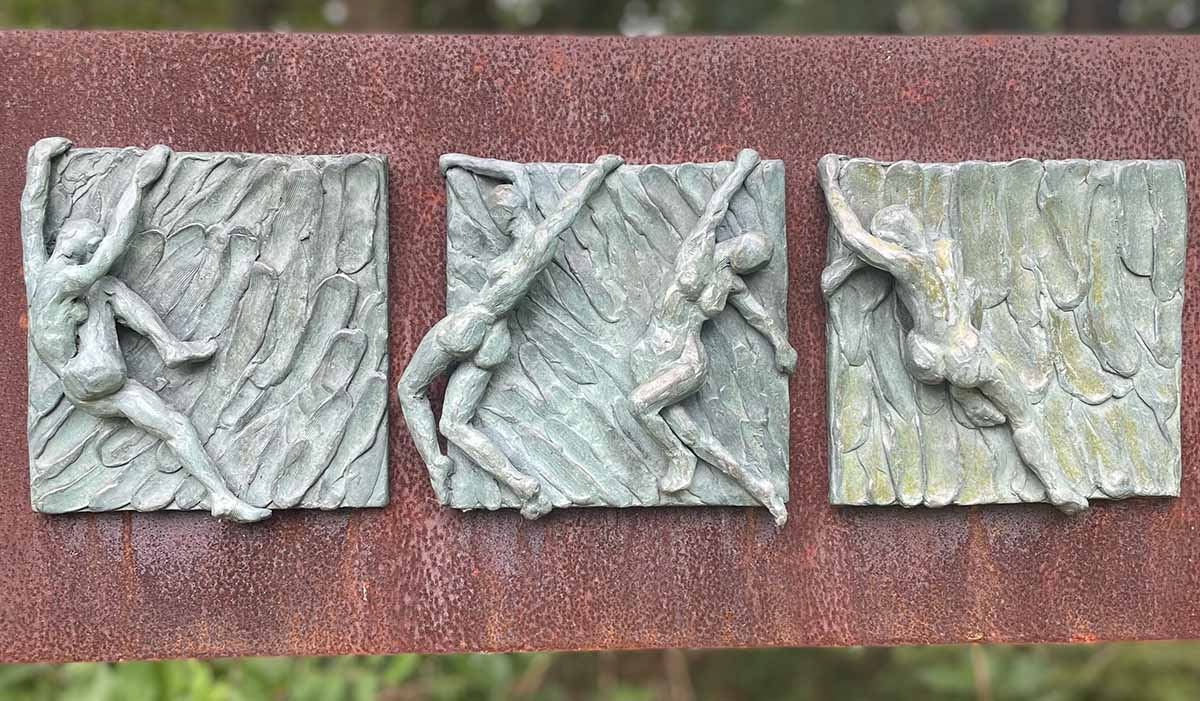
Into the open by Keziah Burt
This middle panel of the three depicts two figures hanging off the square bed-like frame, holding almost impossible twisted poses. Clinging to the edges of the frame, pulling and reaching to find release. There is tension in it and yet somehow there is calmness too. The whole exhibition was about being in the water, surrendering to the currents and allowing my body to fine ease in the cold.
During a weeklong Artist’s Residency at the National Army Museum in Chelsea in May this year, I sculpted a portrait of her late Majesty Queen Elizabeth II. The portrait bust, now cast in bronze and part of the museum’s permanent art collection, depicts her Majesty as an eighteen-year-old Princess Elizabeth in her ATS (Auxiliary Territorial Service) uniform. Queen Elizabeth II joined the army in 1944 and trained as a mechanic and driver. This bust is the only portrait made of her at this time and in this uniform.
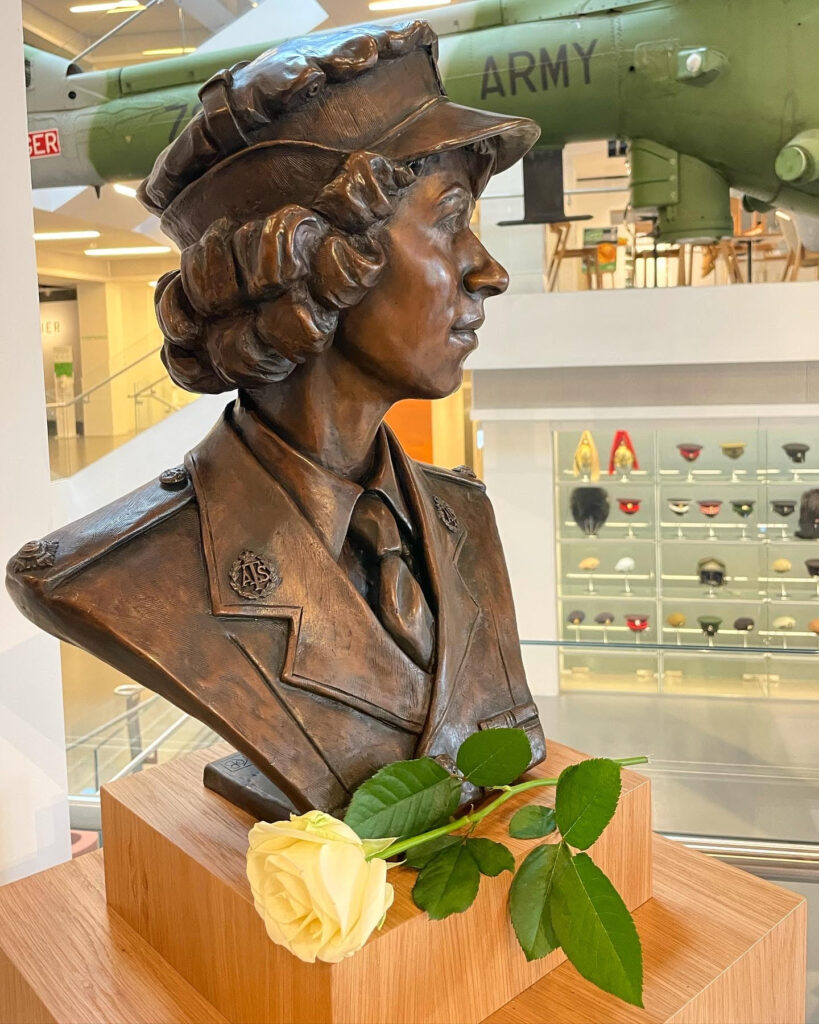
A sculpted portrait of her late Majesty Queen Elizabeth II by Keziah Burt
As a military spouse, I was honoured and delighted to have been chosen to sculpt the bust but was acutely aware of the demands six days of stand-up sculpting would have on my hEDS. Managing my hEDS can be tough at the best of times, but even though I knew it would be incredibly painful, there was no way I was going to let it hold me back from such an incredible opportunity.
I had been working as a full-time secondary school teacher when I was commissioned to create the portrait. Juggling a full-time job, parenting, and taking private sculpture commissions in any spare time I could find, I realised that the combination of all three was taking too much of a toll on my body. It really wasn’t sustainable long term, so something had to give. This commission from a National Museum gave me self-belief to step out of teaching and into my dream job as a full-time artist. But was my body up to the job?
Having struggled with managing my hypermobility since childhood I went on to choose two very physically demanding careers in teaching and sculpting. I must confess to having a bit of a track record of pretending there isn’t really a problem, until it becomes very apparent that there is. I think I just keep going and particularly in teaching, term time is relentless. Having hEDS means you look like everyone else, even when you are living in constant pain and inevitably you become a stoic master of endurance. You find yourself pushing your limits a bit too far, refusing to admit your body can’t always do what your mind wants it to. When the commission was awarded, I knew I needed a proper strategy to manage my pain and the workload during the Artist Residency.
Support from EDS UK was game changing for me. I reached out and was given articles, advice, information, top tips for pain management and support that I hadn’t received from doctors. Medical professionals’ answers were always ‘let’s try different pain meds’, ‘these might make you drowsy’ or ‘these might cause gut problems.’ I have never found a simple pill that fixed any of my EDS symptoms.
The key for me has been precisely what the EDS UK team suggested, a multi-pronged attack of hEDS management. This meant being responsive to my body’s needs each day and never giving up. Also, really investing in myself and taking proper consistent, quality care of my body by focusing on maintaining strength and stability through a combination of the following:
Activities:
- Swimming as often as possible
- Regular personal training, with a PT who understands my diagnosis
- Yoga within my boundaries
- Pilates to strengthen my core
- Weight training- (yes, I never thought this was possible either- but it is)
- Walks in the woods for physical and mental health.
Pain management is key (sadly Gin and Tonic is not actually the answer!)
- Regular massage with an expert deep tissue specialist (actual heaven)
- Foam roller
- Shakkti matt
- Massage gun
- TENS machine is a godsend
- Cold water swims as often as I can, quick dips are perfect
- Going to bed and sleeping.
So now I am much better at giving myself a break when I need it. I’m also much better at maintaining the elusive ‘goldy-locks spot’ of just enough exercise and strength training to not break myself or result in ‘lay down’ days.
“I think the constant joint pain becomes something you feel you just must learn to live with. You just stop trusting your body because you break so often. Living with chronic pain isn’t something that we often speak about, because unless you live with it, it is incredibly hard for others to relate to. There is also a feeling of defeat that comes with having to explain why your body doesn’t work properly, yet again, and again. And no, it’s permanent and no there’s no cure. This is just our life.”
Keziah Burt
So how do you manage it, with work/ kids/ sculpting? How do you make dreams a reality?
It’s a juggle, but you learn to slow down and pace yourself. If you know your hEDS symptoms are worst around your period, then you plan for that. And most importantly, you never give up. Yes, there will be days when you can’t do what you want but you have to find the small pockets of pleasure, the moments of joy amidst the pain.
And there are so many if you look for them. As I write this, my back is in pieces, and I know I need to lie down because tomorrow I have a three-hour drive to do. But I also know that I will swim tomorrow and that will ease my body. I’ll lie down on my spikey mat and let it work its magic for half an hour. And if that doesn’t work, I’ll get my TENS machine on.
“It is such a strange thing to know your body is so vulnerable and yet simultaneously completely and utterly trust every creative instinct that flows through that same body.”
Keziah Burt
I feel like I was always meant to be a sculptor, it’s in my bones. But it has taken my hEDS diagnosis and some serious episodes of ‘bobblehead’ (when your head feels like its’ weight will snap your neck) to make me realise that, if I want to live this artist life, I need to take much better care of the body that makes that life possible.
So, I hope this story makes you realise you can do more than you think. To find the stuff that brings you joy and pursue it relentlessly, and just have the tools in your box to manage your symptoms.
I never believed my body would be in the best shape of my life at 41 but it is. I am stronger and managing my pain in a positive way.
You can find our more about Keziah Burt on her website https://keziahburt.co.uk/